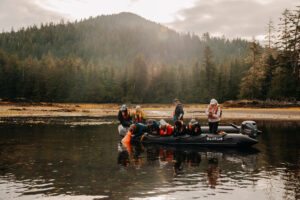

Header image credit: Dean McCurdy
British Columbia’s coastline holds an astonishing diversity of marine life, and we’re continually grateful for the chance to witness so much of it firsthand. Even among this richness, killer whales remain a standout. During our 2025 season, we were treated to 16 sightings of different groups. Each encounter, whether a brief pass or an extended moment alongside them, offered its own remarkable experience.
You see, these aren’t just any killer whales; we know exactly who they are. Each individual carries its own signature: unique saddle and eye patches (the white markings on their bodies), along with the notches and scars that accumulate on their dorsal fins over a lifetime. Together, these features make it possible for us to recognize, identify, and even follow the lives and movements of these whales over time [1].
Since Dr. Michael Bigg led the first killer whale research program in British Columbia in 1970, our understanding of these whales has grown tremendously. Today, we know that three distinct ecotypes call these waters home: Bigg’s (Transient), Resident, and Offshore killer whales. Each ecotype has its own specialized diet. Bigg’s hunt marine mammals like seals, Residents focus primarily on salmon, and Offshores target sharks and rays. These dietary differences shape where the whales travel, how they behave, and even subtle aspects of their physical appearance. [2]. We also know that individuals live in tightly knit, matriarch-led family groups, each exhibiting a wide range of behaviours, geographical preferences, and even its own dialect [3, 4, 5].
Here’s a look back at some of our most memorable sightings of our 2025 expedition season aboard the schooner Passing Cloud – and what made each encounter remarkable in its own way.
The Gathering
Date/Time: July 26, 2025 / 1300 hrs
Region/Vessel: Gwaii Haanas National Park Reserve / Passing Cloud
Location/Position: ~1.5 nm north of Dodge Point, Lyell Island / 52.7492°N, 131.498°W
Ecotype: Bigg’s (Transient) Killer Whales
Matriline/Individuals: T007Bs, T023s, T121As, and T059A3 [1, 6]
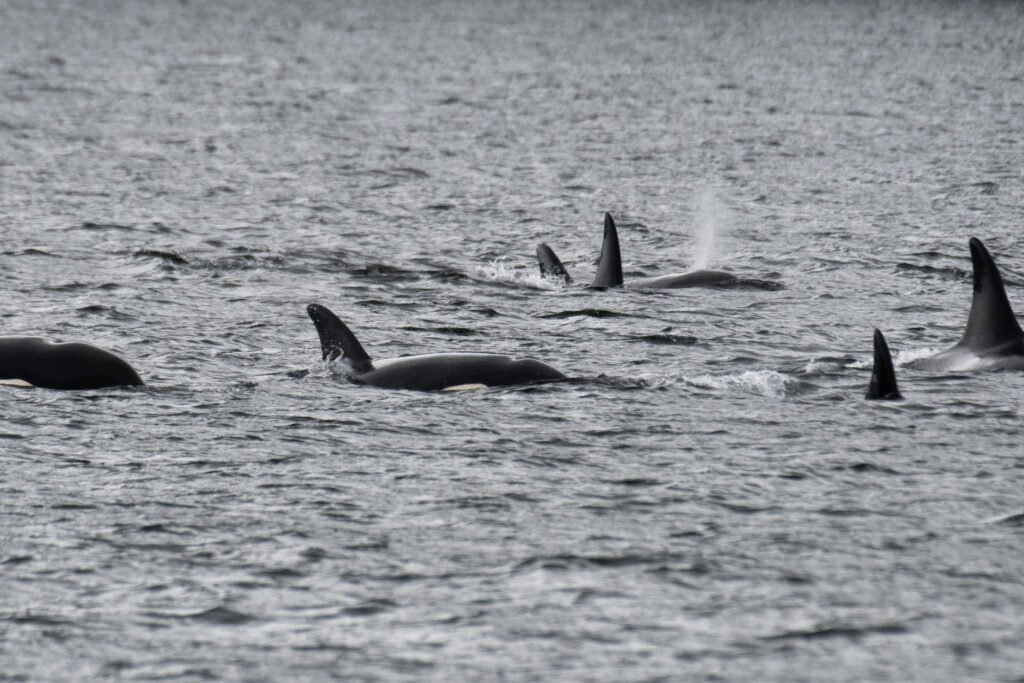
This encounter was memorable for one simple reason: the sheer number of whales. Bigg’s killer whales typically travel within their family groups, which vary in size but rarely include more than five or six individuals. Every so often, though, these groups come together to socialize in what we call a T-party. These interfamily gatherings can range from brief social exchanges to multiday events, with the whales travelling together for hundreds of miles [5]. That’s very likely what we were witnessing on this occasion.
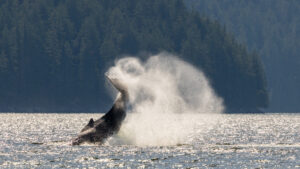
Eleven whales from four different family groups came together, travelling close to shore in a tightly knit formation. Among them was a smaller, notably playful individual with a slight yellow hue to its skin, a one-year-old calf and the newest member of the T121As. This yellow hue is likely the result of a young calf’s thinner blubber layer, which allows underlying blood vessels to show through their white skin [7]. We watched as the calf moved between different members of the group, surfacing often and occasionally splashing its tail – a behaviour known as tail lobbing.
Not all members of the family groups were present. Two individuals from each of the T007Bs and T023s were missing. There are many reasons why orcas might temporarily leave their group, from splitting off during a hunt to seeking out mating opportunities. Like all family groups, the ones we encountered on this occasion have their own history and distinctive behaviours. T007, nicknamed Innis, the mother of T007B and matriarch of the T007Bs, was captured for aquarium display in 1975 but released shortly after [8]. While all groups travel widely, most still show some regional preferences. The T023s, however, are known for unusually extensive movements. They are regularly reported in various locations along the 1,000-mile stretch of coastline from Alaska to the Southern Gulf Islands [1].
A Rare Pair
Date/Time: July 26, 2025 / 1800 hrs
Region/Vessel: Gwaii Haanas National Park Reserve / Passing Cloud
Location/Position: Juan Perez Sound / 52.529°N, 131.4668°W
Ecotype: Bigg’s (Transient) Killer Whales
Individuals: T254 and T268 [6]
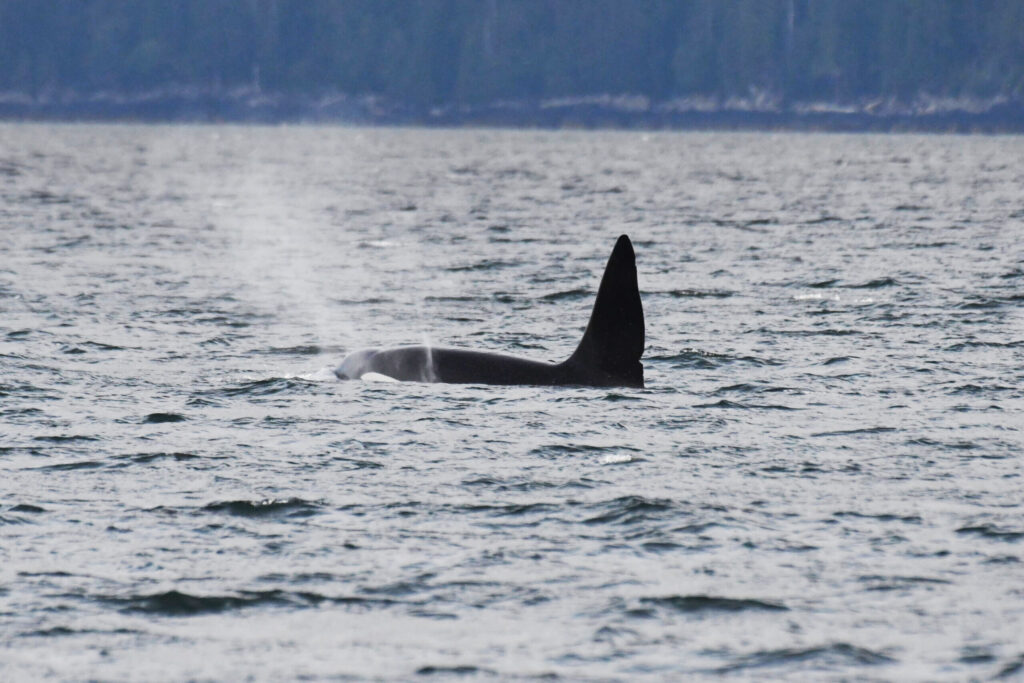
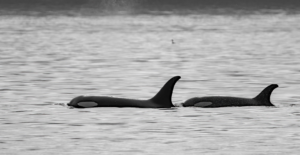
Only a few hours later, we came across two more killer whales, individuals we had never encountered before. They are rarely sighted, and very little is known about them. In fact, these two whales aren’t even listed in the official government identification catalogue. Jared Towers, a local killer whale researcher, helped us identify them through the FinWave project, an online tool for whale identification [6]. What we do know is that T254 is a lone traveling female who is often observed with with other unrelated individuals. In this instance, a large male, T268. Lone traveling killer whales are rare, and lone females even more so. Killer whales are matriarchal animals travelling in family groups led by females, with offspring typically remaining with their mothers for life. It remains unknown why T254 usually travels alone or whether she has ever had offspring of her own. We watched the pair move alongside us for a short while, their fins slicing through the calm water. Then, in true rare whale fashion, they vanished as quickly as they had appeared.
Crossing Paths with a BC Coast Icon
Date/Time: August 20, 2025 / 1940 hrs
Region/Vessel: Hecate Strait / Passing Cloud
Location/Position: ~5 nm west of McInnes Island Light / 52.256°N, 128.7794°W
Ecotype: Northern Resident Killer Whales
Matriline/Individuals: A35s and A24s [9]
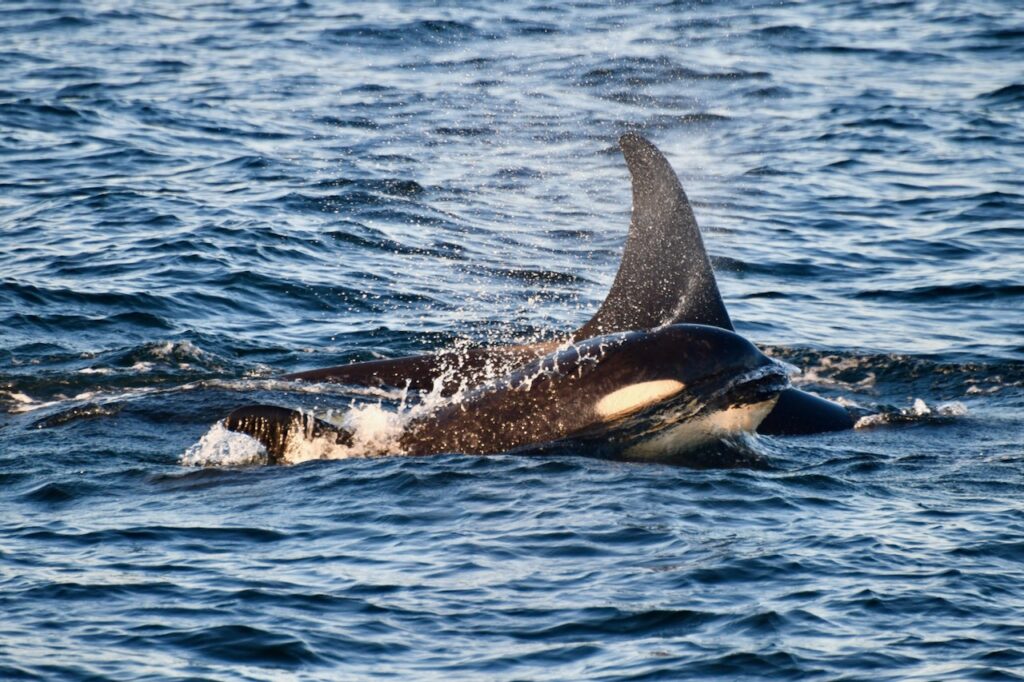
This encounter took place during our Hecate Strait crossing, which we used as an opportunity to conduct a marine mammal survey. We recorded dozens of humpback whales, fin whales, and porpoises along the way. As we neared the mainland coast, we came across a group of roughly 15 killer whales. Their large group size and rounded dorsal fins made it clear that these were not Bigg’s mammal-eating whales, but rather the fish-eating Northern Resident killer whales [9].
Residents vocalise far more often than Bigg’s, and they are generally more surface-active and “playful” [10], which was certainly true during this encounter. With our engine shut down, the whales began surfacing around us, even rolling upside down and swimming backwards as they passed. We lowered our hydrophone to listen in on their calls. Dr. Volker Deecke, our onboard killer whale specialist, quickly recognised them as A-clan calls. Northern Residents are grouped into three acoustic clans, each defined by its own unique call type [9]. Later, photo ID confirmed the presence of A35 and A24 matriline members within the group.
These matrilines carry a long and meaningful history. A10, the mother of A24, was tragically shot by a boater in 1983, leaving A24 to take on the role of matriarch at the relatively young age of 30. This early transition may have contributed to the loss of several of her first calves before they reached adulthood. Over time, however, her later offspring thrived, and one of her grandchildren grew into one of the most well-known orcas along the BC coast: A73, eventually known as “Springer” [11].
In 2002, Springer was found alone and in poor health in Puget Sound near Seattle, hundreds of miles from the typical home range of Northern Residents, while still a young calf. She remained in the area, and both acoustic and visual identification confirmed her identity. Due to the social nature of Northern Resident killer whales, Springer frequently interacted with humans in the busy Seattle region. After extensive discussions and planning, the decision was made to capture Springer and relocate her back to her home waters, where she was eventually reunited with her pod. Springer is still alive today and has since had calves of her own, usually travelling with the closely related A35 matriline, just as they were during this encounter [11].
Old Hunter of the Great Bear Rainforest
Date/Time: August 27, 2025 / 1115 hrs
Region/Vessel: Great Bear Rainforest / Passing Cloud
Location/Position: Fawcett Point, Taylor Bight / 53.081°N, 129.2745°W
Ecotype: Bigg’s (Transient) Killer Whale
Matriline/Individuals: T054 [1, 6]
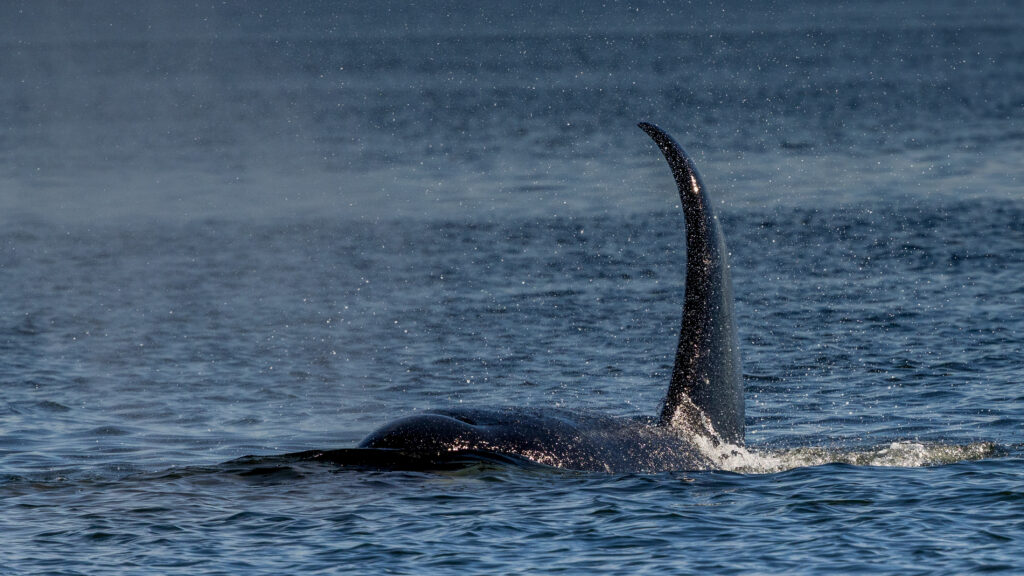
Although killer whales are generally social animals, some are observed travelling alone. In some cases, these lone whales may be the last survivors of their family group, while others appear to have chosen a life in solitude. T054, nicknamed “Seaforth” after a channel in the Great Bear Rainforest, his preferred roaming ground, is one such whale. At 53 years of age, he is one of the oldest males frequenting the BC coast [7]. On average, male killer whales live to around 30 years, although some do survive into their 60s [12].
Despite his age, Seaforth appears to be doing well. He was reported near a rock commonly used by sea lions as a haul-out. Shortly after we spotted him, we noticed a juvenile Steller sea lion separated from the rest of the group. Seaforth quickly sped up and charged toward it. A few big splashes later, the sea lion was gone. After the hunt, we deployed our onboard hydrophone and, to our surprise, Seaforth was vocalising. Bigg’s killer whales often vocalise after a successful hunt, possibly as a way to celebrate with other group members [10], yet Seaforth was entirely alone. Dr. Deecke suggests he may have been trying to call out to other groups. The area where we observed him in is regularly used by many killer whales, and his vocalisations could have easily been heard by others several miles away.
We also observed multiple humpback and fin whales nearby. While a lone killer whale is unlikely to attack such large whales, these species typically keep their distance or group together to ward off a potential predator. In this case, however, the other whales appeared entirely unbothered by Seaforth, as if they recognized that he posed no threat.
Chase, Catch, Celebrate
Date/Time: September 29, 2025 / 1500 hrs
Region/Vessel: Great Bear Rainforest / Passing Cloud
Location/Position: Jermain Point, Mathieson Channel / 52.4076°N, 128.3263°W
Ecotype: Bigg’s (Transient) Killer Whale
Matriline/Individuals: T059s [1, 6]
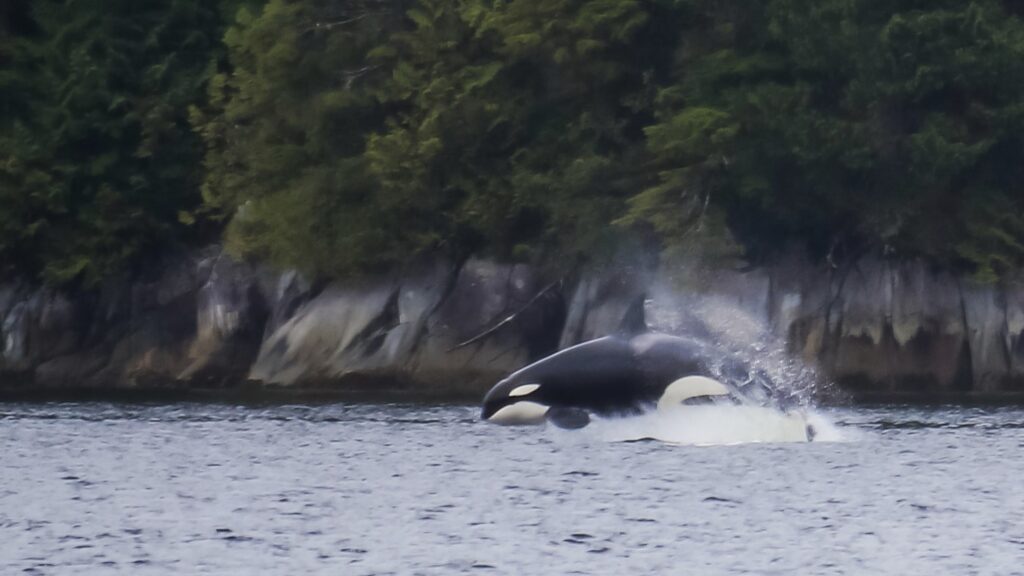
This encounter began abruptly, with sudden splashes breaking the calm water. The whales moved at high speeds along the shoreline, breaching and diving at sharp angles. It quickly became clear that they were hunting, targeting two nearby Dall’s porpoises. While we didn’t witness the kill itself, the behaviours that followed made it obvious that the killer whales had successfully secured their prey.
After the high-speed chase, the whales began making long, coordinated dives, swimming closely together, likely sharing the catch. Soon after, they slowed down in a nearby bay and started socialising. We observed spy hopping, tail-lobbing, and heard them vocalising at the surface. This combination of behaviours is what we refer to as a celebration, a clear sign of a successful hunt. Once they had re-energised, the whales regrouped and resumed their usual travel.
We were incredibly fortunate to witness the full sequence of an orca hunt and its aftermath. The T059s regularly frequent the waters of the Great Bear Rainforest and Northern Vancouver Island and rarely travel farther south [1].
Every family group, every individual whale, and every encounter has its own story. Killer whales are not only mesmerizing to watch, but the data collected during these encounters – such as individual identifications, sighting locations, and observed behaviours – provide invaluable insights that help drive research and conservation of this remarkable species. Join us on an expedition and discover the story of your own unforgettable killer whale encounter.
References
[1] Towers, J. R., Sutton, G. J., Shaw, T. J. H., Maleson, M., Matkin, D., Gisborne, B., Forde, J., Ellifrit, D., Ellis, G. M., Ford, J. K. B., & Doniol-Valcroze, T. (2019). Photo-identification Catalogue, Population Status, and Distribution of Bigg’s Killer Whales known from Coastal Waters of British Columbia, Canada. Fisheries and Oceans Canada.
[2] De Bruyn, P. J. N., Tosh, C. A., & Terauds, A. (2012). Killer whale ecotypes: is there a global model? Biological Reviews, 88(1).
[3] Bigg, M. (1982). An assessment of killer whale (Orcinus orca) stocks off Vancouver Island, British Columbia. Report of the International Whaling Commission.
[4] Deeke, V. B. (2009). Stability and change of killer whale (Orcinus orca) dialects [University of British Columbia].
[5] Baird, R. W., & Whitehead, H. (2000). Social organization of mammal-eating killer whales: group stability and dispersal patterns. Canadian Journal of Zoology, 78(12).
[6] Bay Cetology. (2022). Finwave. https://finwave.io/
[7] Raverty, S., St Leger, J., Noren, D. P., Huntington, K. B., Rotstein, D. S., Gulland, F. M. D., Ford, J. K. B., Hanson, M. B., Lambourn, D. M., Huggins, J., Delaney, M. A., Spaven, L., Rowles, T., Barre, L., Cottrell, P., Ellis, G., Goldstein, T., Terio, K., Duffield, D., Gaydos, J. K. (2020). Pathology findings and correlation with body condition index in stranded killer whales (Orcinus orca) in the northeastern Pacific and Hawaii from 2004 to 2013. PLoS ONE, 15(12).
[8] Our Wild Puget Sound. (2025). Meet the transient orcas – Bigg’s killer whales – of Puget Sound. https://www.ourwildpugetsound.com/journal/meet-the-transient-orcas-biggs-killer-whales-of-puget-sound
[9] Towers, J. R., Pilkington, J. F., Gisborne, B., Wright, B. M., Ellis, G. M., Ford, J. K. B., & Doniol-Valcroze, T. (2014). Photo-identification Catalogue and Status of the Northern Resident Killer Whale Population in 2019. Fisheries and Ocean Canada.
[10] Deecke, V. B., Ford, J. K., & Slater, P. J. (2004). The vocal behaviour of mammal-eating killer whales: communicating with costly calls. Animal Behaviour, 69(2).
[11] OrcaLab. (n.d.). Springer’s Story. https://orcalab.org/springers-story/
[12] Olesiuk, P. F., Ellis, G. M., & Ford, J. K. B. (2005). Life History and Population Dynamics of Northern Resident Killer Whales (Orcinus orca) in British Columbia. Fisheries and Ocean Canada.