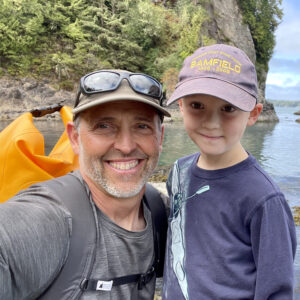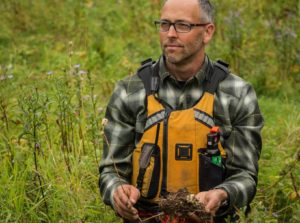

I’m often asked which of our expedition regions is my personal favourite. Or, if I had to choose just one of our expeditions, which would it be? I’ve had the privilege of exploring, studying, and guiding throughout the BC coast for most of my life. It is truly an amazing and magical place. But, without hesitation, my answer is always the same: Gwaii Haanas National Park Reserve, National Marine Conservation Area Reserve, and Haida Heritage Site. Or simply “Gwaii Haanas” for short.
Don’t get me wrong – I absolutely love the Great Bear Rainforest, Northern Vancouver Island, the west coast of Vancouver Island, and the Salish Sea, as these regions all offer a wide range of spectacular experiences. However, for me, Gwaii Haanas offers the greatest number and diversity of spectacular experiences. From the powerful presence of Haida history and living culture to moss-laden towering old-growth forests, remote beaches, endemic species, and extraordinary marine biodiversity, Gwaii Haanas offers something truly unlike anywhere not just on the BC coast, but anywhere on Earth.
Whether you’ve travelled there before or are dreaming of your first visit, this post offers a closer look at what makes this remote island archipelago so endlessly inspiring.
1. Protected From Seafloor to Mountain Top
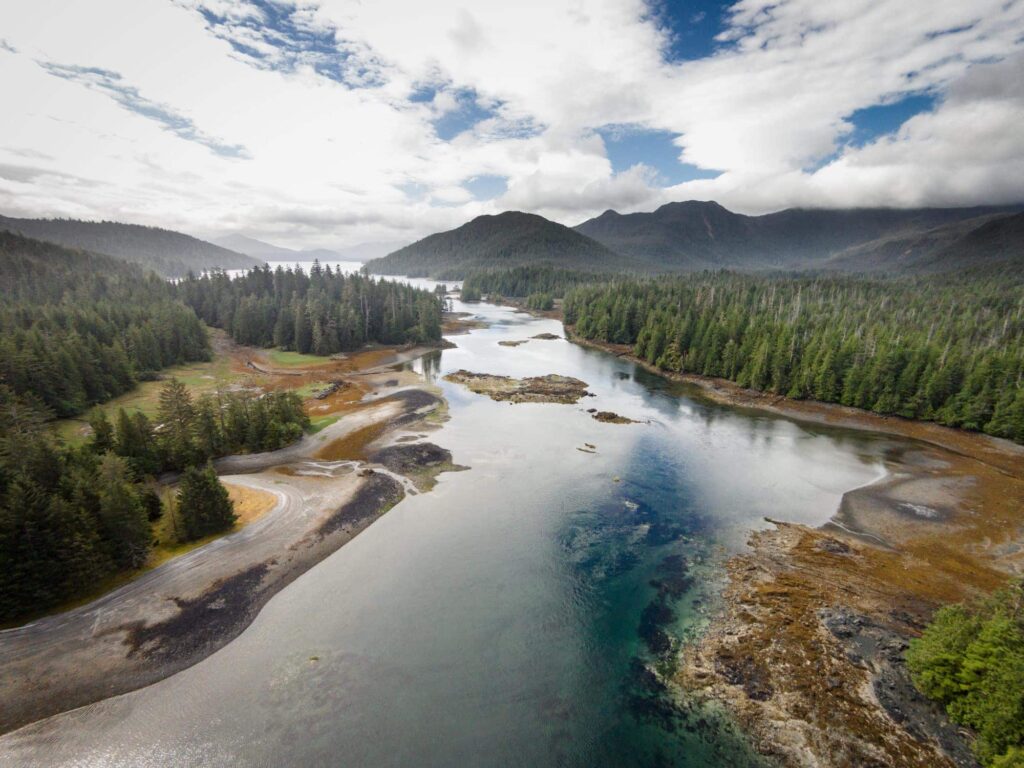
Through an incredible series of events led by the Haida Nation – including protests, blockades, and the arrest of Haida elders – Gwaii Haanas became a globally significant protected area that all Canadians, and global citizens, should be incredibly proud of.
It is perhaps the only protected area in the world that extends from the deep-sea floor to the mountaintops of adjacent land masses. Nearly 50% of marine areas extending 10 kilometres from land is closed to all commercial and recreational fishing, creating a massive marine protected area (MPA).
Not only do these protected areas safeguard species and ecosystems within the reserves, once fish densities become high enough, they export individuals into non-reserve areas where they become available to commercial and recreational fishing – a process known as “spillover”.
Furthermore, for populations of long-lived fishes such as rockfish, lingcod, and halibut, the protection of large females is particularly important. These individuals produce disproportionately more eggs and larvae, which once released, are transported by ocean currents and help replenish downstream populations within both reserve and non-reserve areas.
Gwaii Haanas is a huge conservation success story!
2. Diversity of Habitats and Ecosystems
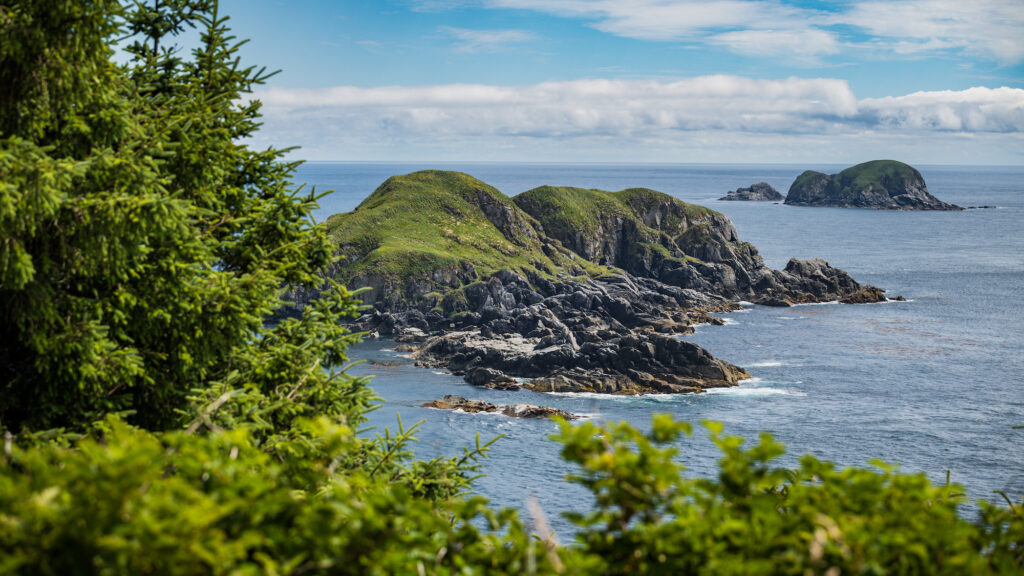
By virtue of its location at the very edge of the continental shelf, and its sheer size – 1,500 km2 of land and approximately 3,400 km2 of ocean – Gwaii Haanas protects an astonishing diversity of habitats, ecosystems, and species. These range from sperm whales to alpine meadows, and from monumental old-growth forests to vast undersea kelp forests teeming with life.
As a marine ecologist and wildlife enthusiast more broadly, every time I visit Gwaii Haanas, I feel like I’m stepping back in time. I feel as though I’m witnessing a world much as it was 5,000 years ago. I’m also addicted to the wildlife we do – or could – encounter there, from ocean sunfish and tufted puffins to Risso’s dolphins, Offshore killer whales, sperm whales, and maybe one day, a basking shark, or even a Blue whale.
3. Abundance of Endemic Species – “Galapagos of the North”

The Haida Gwaii Archipelago is the most distantly separated large group of islands associated with North America. This long-term isolation from mainland populations has resulted in the evolution of a rich diversity of endemic species (predominantly at the subspecies level), leading to comparisons of Haida Gwaii as the “Galapagos of the North.”
This endemism – meaning species found nowhere else – is incredibly diverse, extending from mosses, flowering plants, and insects, to fish, birds, and mammals. These include, but are not limited to, genetically distinct subspecies of the Hairy Woodpecker, Saw-Wet Owl, Goshawk, Varied Thrush, River Otter, Dusky Shrew, Pine Marten, American Black Bear, and the now-extinct Dawson Caribou.
Another fascinating example of endemic mammals is the Haida ermine (Mustela haidarum). Once thought to be a subspecies species of mustelids (i.e., the weasel family), it was recently designated as distinct species, found only on Haida Gwaii and the Alexander Archipelago of Alaska. As an aside, in the Haida language, the Haida ermine is known as “dáayaats” in its brown summer coat and “tlag” in its white winter coat.
As someone who thinks often about the process underlying speciation and the importance of biodiversity, visiting Gwaii Haanas is always a very thought-provoking and reverential experience. We always look forward to encountering some of these Haida Gwaii subspecies during our expeditions.
4. Monumental Old-Growth Forests
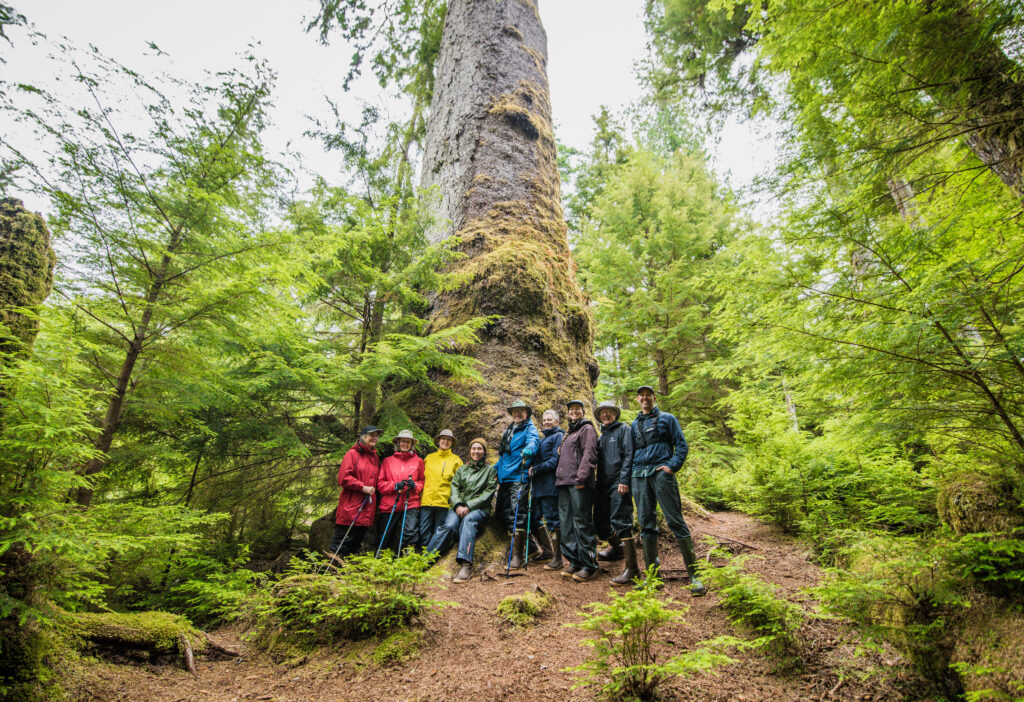
Speaking of reverential, let’s consider the massive old-growth forests of Haida Gwaii, and Gwaii Haanas specifically. Coastal British Columbia is home to vast tracks of ancient coastal temperate rainforest, a globally rare ecosystem.
It is here on the coastal margins where the Pacific Ocean collides with coastal mountains and creates mild temperatures year-round and massive annual rainfall in the range of 3-5 metres per year. These conditions produce ideal growing conditions for massive, or monumental, old-growth forests of western red cedar, western yellow cedar, western hemlock, and Sitka spruce. It’s also here where wild Pacific salmon return annually in vast numbers to spawn. In doing so, they fertilize these forests with the ocean-derived nutrients accumulated over the course of their lives, contributing tremendously to the growth and size of riverside forests.
Sadly, much of British Columbia’s old-growth forests have been lost to industrial logging. In fact, protection from logging was one of the key drivers that led to the creation of Gwaii Haanas. With this in mind, our explorations of the incredible old-growth forests here feel even more poignant.
5. Globally Significant Seabird Populations

Haida Gwaii is home to more than 1.5 million nesting seabirds across 12 species, most of which utilize the remote islets and ancient forests where they excavate their nests and provision their young. Cassin’s auklets, in particular, account for approximately 75% of the entire seabird nesting population on Haida Gwaii and make up an estimated 80% of the global population. Similarly, approximately 50% of the global population of ancient murrelets (~256,00 breeding pairs) nest on Haida Gwaii, with the vast majority of these found along the eastern shores of Gwaii Haanas.
The remaining species of nesting seabirds here include Fork-tailed and Leach’s storm petrels, Black oystercatchers, Pigeon guillemots, Tufted and Horned puffins, Rhinoceros auklets, Common murre, Glaucous-winged gull, and Pelagic cormorant. Marbled murrelets also nest here high in the canopy of Haida Gwaii’s old-growth forests. Many non-nesting seabirds are frequently encountered here as well, including Sooty and Short-tailed shearwaters, Black-footed albatross, Northern fulmars, and Parasitic jaegers.
6. Marine Biodiversity
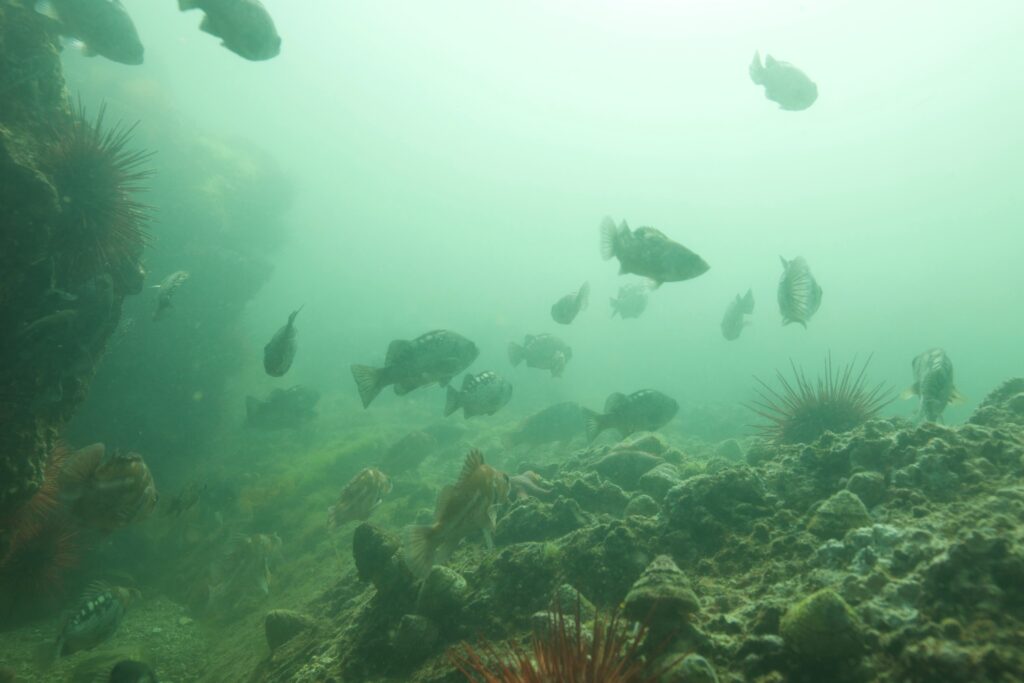
As a marine ecologist, my interests, training, and expertise have focused primarily on rocky intertidal and shallow subtidal communities and ecosystems. It’s in these places that I still get that “kid in a candy store” feeling every time an extra low tide comes along, or I don my wetsuit and slip below the surface.
In Gwaii Haanas, thanks to exceptionally large tides, high summertime water clarity, and complex oceanographic conditions, I’m in my glory.
For our guests, this suite of remarkable conditions allows us an exceptional glimpse into this underwater world of strange and beautiful marine organisms, biodiversity, and fascinating behaviours. Perhaps no one place in Gwaii Haanas exemplifies this opportunity than Burnaby Narrows. This shallow, current-swept passage between Burnaby Island and Moresby Island, which we visit on all our expeditions, provides us with the low tide opportunity to peer into this world. Guests can observe everything from sea cucumbers, bat stars, century-old sea urchins, colourful seaweeds, and even rockfishes! It is always a highlight for our guests and crew alike.
7. Sensational Sailing
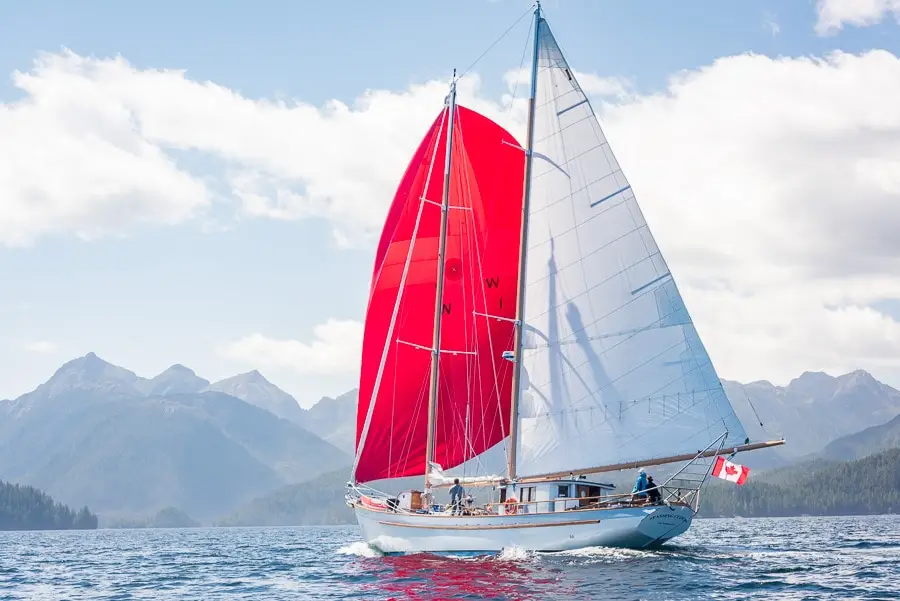
Don’t get me wrong. We LOVE sailing, the schooner Passing Cloud – and soon our new 70’ sailing ketch, Ocean Wayfinder. However, wind strength and direction, and the distances we need to travel on a daily basis to all the amazing places we want to take you, frequently limit our time spent under sail. This is particularly true of the long, narrow channels and fiords of the Great Bear Rainforest. Yet summertime westerlies and ample sea room make Gwaii Haanas one of our favourite places for sailing.
We’ve been sailing Passing Cloud throughout the BC coast for 14 expedition seasons, and nearly all of our most memorable days under sail have been in Gwaii Haanas.
8. Magnificent Marine Mammals
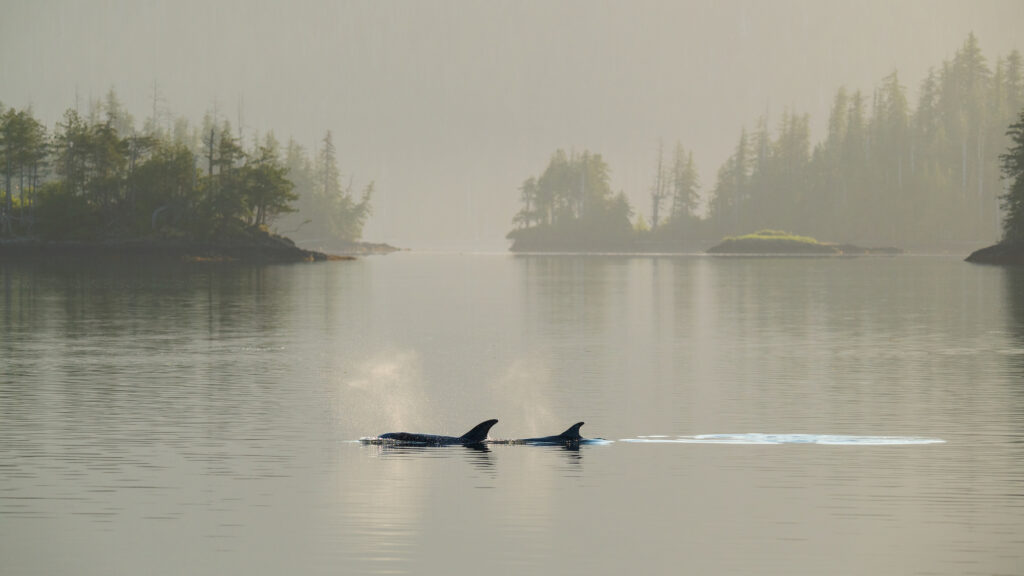
Gwaii Haanas is situated at the edge of the continental shelf, close to nearshore, offshore, and deep-sea ocean ecosystems, making the diversity of marine mammals here the highest of all our expedition regions.
In addition to abundant populations of Humpback whales, Harbour seals, Steller and California sea lions, Dall’s and Harbour porpoises, Pacific white-sided dolphins, and Northern resident and Bigg’s (Transient) killer whales, we’re occasionally treated to glimpses of rarer marine mammals, including Fin whales, Sperm whales, Risso’s dolphins, and Northern fur seals.
Sea otters are recovering here too, and it’s entirely possible that one day soon we’ll finally encounter a Blue whale. Fingers crossed!
9. Deep Time Cultural Footprint of the Haida

Extensive archaeological investigation, in tandem with oral history and traditional knowledge, have demonstrated unequivocally that the Haida have lived on Haida Gwaii for at least the last 14,000 years, and possibly much longer.
Despite sea level changing radically during this time due to the region’s history of glaciation, the cultural materials, or “footprints” of these ancient Haidas are still found across the landscapes of Gwaii Haanas. These include ancient village sites, shell middens, stone and wooden stake fish traps and weirs, stone tools, and a wide variety culturally modified trees.
These materials provide invaluable insights into the ancient “lifeways” and “subsistence technologies” of the Haida, and the ecosystems in which they lived and depended on. It’s always thrilling for our guests and crew to step into the past in this way.
10. Haida Gwaii Watchmen Program and Sites
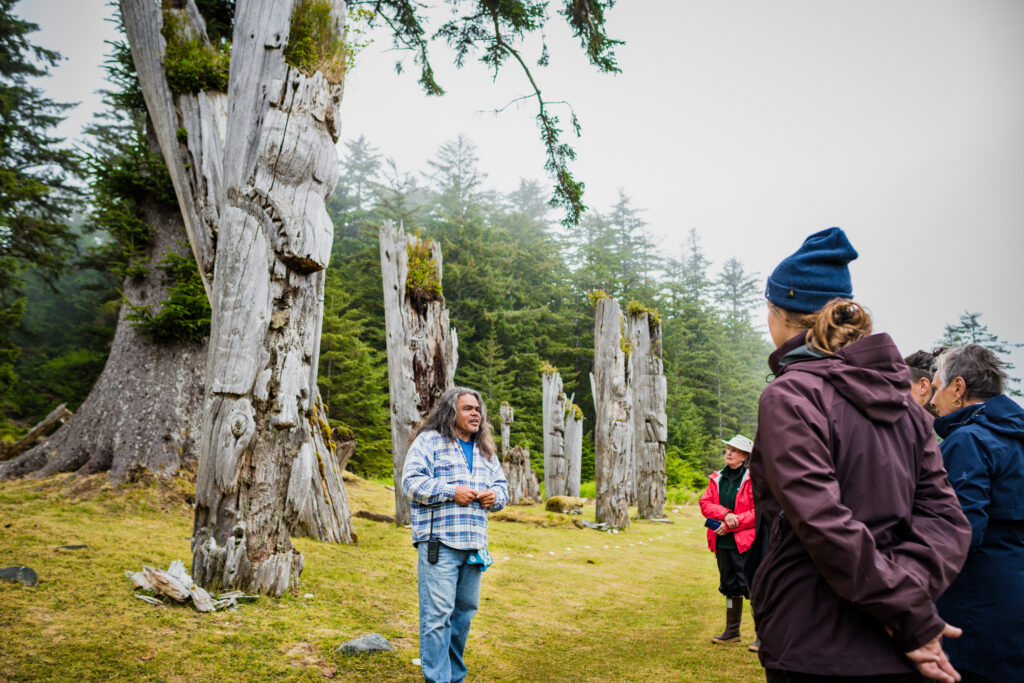
Last but not least, the jewel of Gwaii Haanas is undoubtedly the Haida Gwaii Watchmen Program and the five ancient village sites within Gwaii Haanas, which they serve as guardians to protect: K’uuna Llnagaay (Skedans), T’aanuu Llnagaay (Tanu), Hlk’yah Gaw Ga (Windy Bay), Gandll K’in Gwaay.yaay (Hotspring Island), and SGang Gwaay (Anthony Island) UNESCO World Heritage Site.
While the Watchmen’s primary role is site protection, they also provide incredibly insightful tours for visitors, generously sharing their knowledge about each site as well as their personal experiences about contemporary life as Haida. Without exception, these visits leave our guests filled with both knowledge and hope. And to our hosts, in thanks and in Haida we say, Haawa!