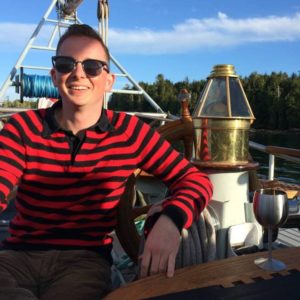

As the resident office-based team member at Outer Shores Expeditions, I spend a lot of my time talking about places I’m not currently standing in.
My job involves describing them. Explaining them. Answering questions about them. Sharing my feelings about why several days aboard a sailboat exploring the coast of British Columbia might just be one of the most rewarding things you’ll ever do.
And I mean it when I say that.
But there is something slightly surreal about promoting a place when you’re sitting at a desk, staring at a screen, possibly eating a sandwich while answering emails. Sometimes you begin to feel like a travel agent for somewhere mythical.
So whenever I get the chance to actually step aboard one of our ships and take in an expedition for myself, obviously I go for it.
Last May, that opportunity came in the form of a four-night voyage exploring the Gulf Islands and the wider Salish Sea.
An Easy Start
One of the best things about exploring this particular region with Outer Shores is just how easy it is to start. I flew into Victoria International Airport. Then there was about a ten-minute drive to Brentwood Bay.
That’s it.
You step off the plane and you are almost immediately at the doorstep of the very landscape you came to explore.
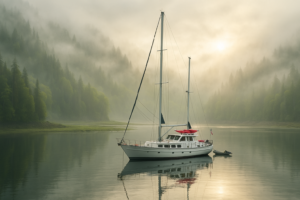
Brentwood Bay sits quietly along the Saanich Peninsula, surrounded by forested hills and calm water. At the end of the public dock, we were helped into the zodiac and felt the first touch of sea air against our faces as we motored out toward Passing Cloud where she waited in the deeper waters at the edge of the bay.
Stepping back aboard felt oddly like returning to a family cottage. The smell of wood and salt air. The gentle creak of the deck. The familiar layout. All my memories of the last time I had been aboard came rushing back.
Ships have personalities, and our ships’ personalities are unmistakably welcoming.
The crew greeted everyone as if we were old friends returning from a long absence. And in a sense, some of us were. Several guests had sailed with us several time before, which is something I always find incredibly heartening.
In the office, I often speak with people months before their expedition. We email, we talk through travel plans, and I help them prepare for the journey ahead. So when it does happen that I actually get to meet them in person aboard the ship, it proves especially rewarding.
And for those who were joining us for the first time, I knew something they didn’t yet know: by the end of the expedition, there’sa genuine sense of familiarity and appreciation among everyone aboard. A few days spent exploring a place like this together has a quiet way of bringing people closer. That’s simply what tends to happen on these voyages.
A Gentle Introduction to the Gulf Islands & Salish Sea
We eased away from Brentwood Bay that morning and began travelling through the sheltered waterways of the Gulf Islands. Our initial destination was the north side of Prevost Island, where we planned to anchor in a quiet spot known as James Bay.
The Gulf Islands are scattered across the Salish Sea like someone dropped a handful of forested stepping stones between Canada and the United States. Each island has its own character. Some are home to small communities, others remain largely wild.
The landscape here is largely defined by two trees that quickly become familiar companions.
The first is the towering Douglas fir, whose straight trunks rise resolutely toward the sky. The second is the iconic Arbutus, whose trunks twist and lean, their reddish bark peeling away like curling parchment.
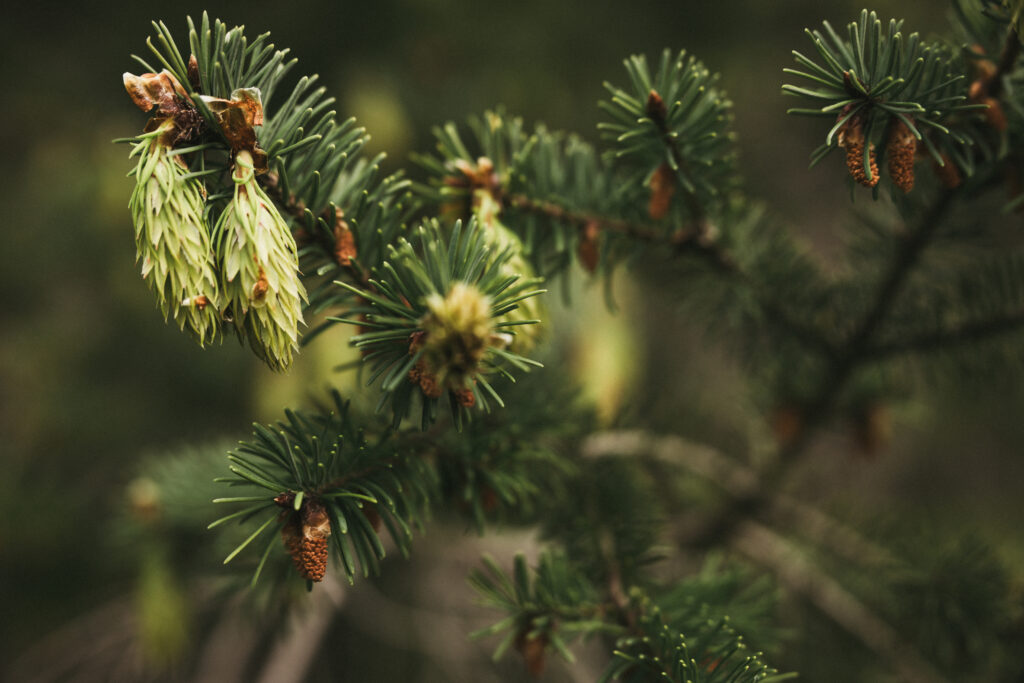
Spring had arrived in earnest. The forests were bright with fresh growth, and the air carried that particular coastal scent of cedar, salt, and something faintly floral.
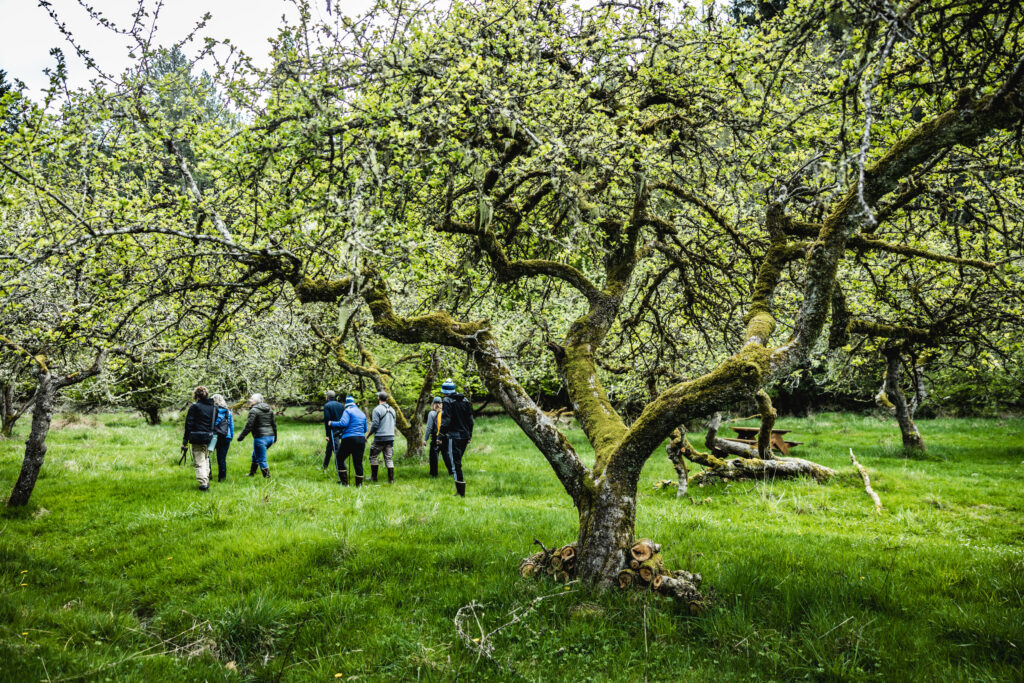
When we reached Prevost Island, we headed ashore for our first hike of the expedition, first passing through a small orchard where apple trees were beginning to leaf out for the season. From there, we wandered up and along the edge of the open forest.
Standing on a cliff edge, looking across the quiet bay where the schooner rested at anchor, I had the slightly embarrassing thought that this was exactly the sort of scene I’m trying to convey to people back in the office. Except now I was standing in it. Still, the words to describe the exact feeling were escaping me. They still do as I write this. It’s something felt.
We spent our first night in the gentle waters of Swanson Channel, already benefiting from the deep sleep induced by breathing in the fresh sea air all day.
Sailing, for the Joy of It
After breakfast the following morning, we continued south, tracing the shoreline north toward Pender Island before turning into the broader waters near Boundary Pass.
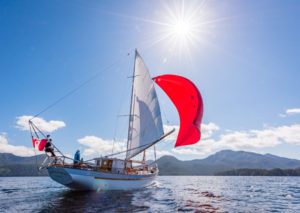
And then something wonderful happened. The crew set all sail. For the next four hours, we did what sailing vessels have done for centuries. We let the wind decide the path. We tacked back and forth across open water with no particular destination in mind. There was no rush. No schedule pressing down on us. Just wind, water, and the quiet rhythm of a wooden schooner doing exactly what she was built to do.
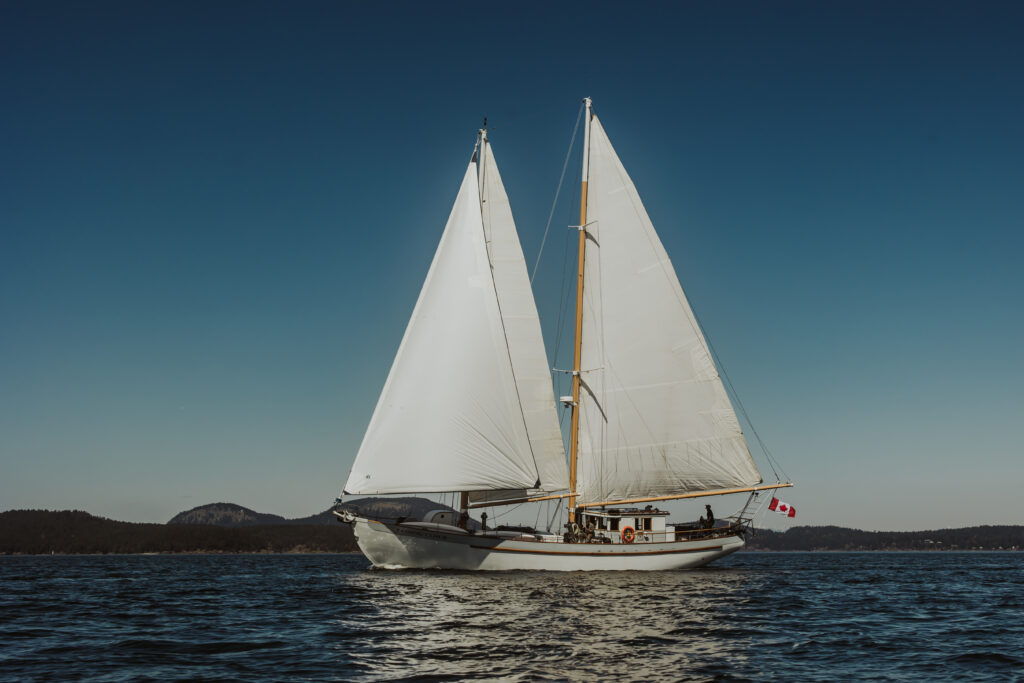
Sailing like this feels strangely liberating. In our daily lives, every movement tends to have a purpose. A meeting to attend. A place to be. But out there on the Salish Sea, the purpose was simply the sailing itself. We spent much of that afternoon watching the sails fill and collapse as we changed direction.
Eventually we eased into Winter Cove on Saturna Island. The tide was high, which gave us enough depth to tuck the schooner into a protected spot for the night.
The cove grew still as evening settled in.
Scenes from a Naturalist’s Notebook
Morning in Winter Cove revealed something remarkable. The shoreline surrounding the cove was lined with shell middens. A midden, for those unfamiliar with the term, is essentially an ancient refuse pile. Shellfish shells, fish bones, and other remnants left behind by people who lived and harvested food along the coast.
But these middens weren’t small. They stretched along the shoreline, layer upon layer of history quietly resting beneath moss and soil. They are reminders that long before anyone thought of these islands as a recreational escape, they were vibrant homelands for communities who have lived here for thousands of years.
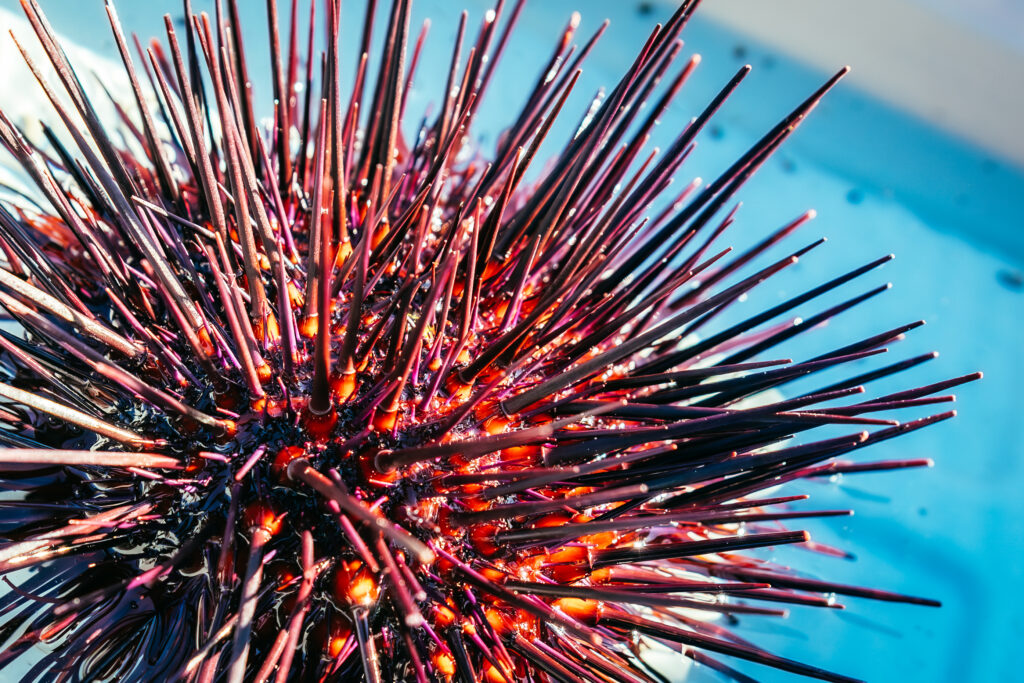
The ecosystem around Winter Cove is astonishingly rich. That morning alone our species list began to resemble something out of an enthusiastic naturalist’s notebook.
River otters darted along the shoreline with their usual chaotic energy. Harbour seals watched us with mild curiosity. A fawn teetered after its mother.
In the shallows we spotted starfish, leather stars, sea cucumbers, juvenile salmon, and delicate forests of kelp swaying with the tide.
Birdlife was equally lively. A Belted Kingfisher rattled overhead. A Great Blue Heron stood statue-like in the shallows, until it chose it’s moment to strike.
It felt like the sort of place where an attentive observer could fill an entire field notebook before breakfast. Or, in our case, after yet another delicious breakfast. And while I’m on the topic…
A Word About the Chefs
Let me take this moment to discuss what I believe may be our true secret weapon at Outer Shores.
The chefs.
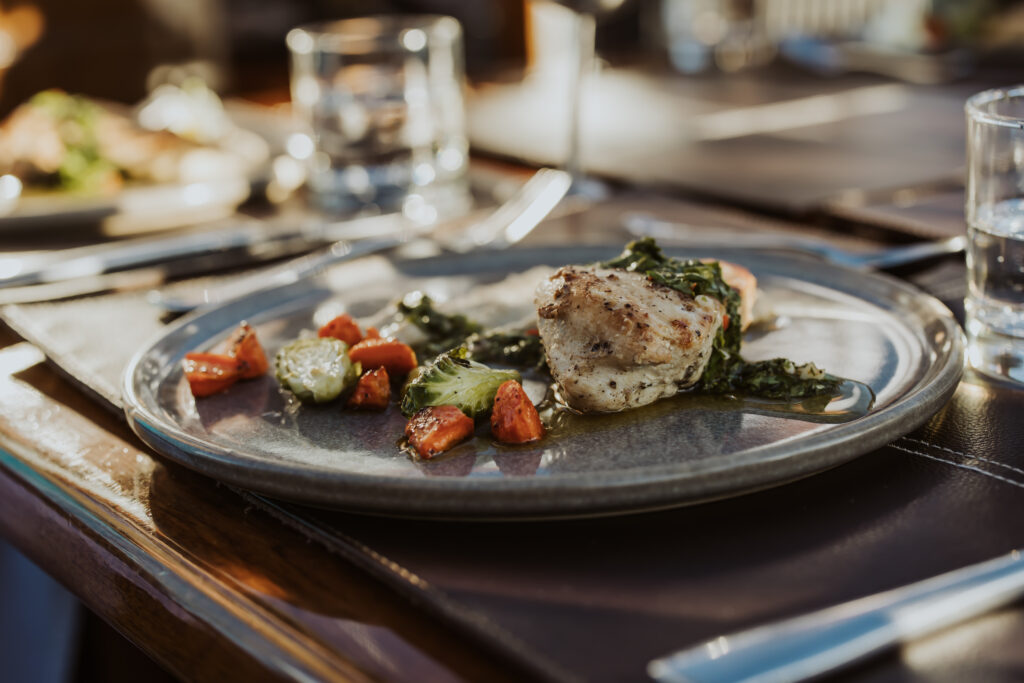
Of course, people rarely join an expedition along the BC coast for the express purpose of enjoying extraordinary cuisine. They come for wildlife, landscapes, culture, and adventure. But the food aboard our ships has a habit of quietly becoming one of the highlights. Our returning guests often ask about chefs by name when they book their next expedition.
It turns out that after a day of hiking forest trails or exploring shorelines by skiff, sitting down to an unexpectedly excellent meal while the ship rests gently at anchor is a deeply satisfying experience.
Through the Passages
After a delicious lunch we cruised through Georgeson Passage, eventually drifting near Anniversary Island.
Bald eagles lined the shoreline, perched like quiet sentinels watching everything unfold. Then suddenly, and quite unexpectedly they engaged in battle with one another. A reminder to always keep your eyes on the lookout, you never know what nature is going to show you next.
Later that afternoon we travelled through Tumbo Channel and headed ashore on Tumbo Island. Tumbo is a small, gently curving island with sandy beaches and quiet wetlands. It feels almost dreamlike. Canada geese nested in the marshes. Red-winged blackbirds called from the reeds.
Towering Douglas fir and scattered Garry Oak trees created a landscape that felt both coastal and surprisingly pastoral. But the real spectacle of the afternoon was waiting offshore.
The Boiling Reef
Just east of Tumbo Island lies an area known as Boiling Reef. Here, the sea floor drops dramatically, forming an underwater canyon nearly 300 metres deep. As powerful tidal currents sweep through the region, the water collides with submerged ridges and walls before surging upward.
The result is a place where the ocean seems constantly alive with movement. It’s also an excellent place to look for whales. And on that particular afternoon, the whales obliged.
Shortly after passing the Boiling Reef, a pair of Killer whales appeared offshore, their dorsal fins slicing through the surface like slow-moving black sails. We watched them for at least an hour.
Time became slightly irrelevant.
Maurice, our expedition guide and deckhand, spoke softly as the whales surfaced and disappeared again along the shoreline. He explained the different ecotypes of killer whales that travel these waters. Some are residents, whose lives are closely tied to the migrations of salmon. Others are Bigg’s killer whales, once called transients, hunters of seals, sea lions, and porpoises.
These were Bigg’s. And they were hunting.
The duo moved with a quiet purpose along the shoreline, surfacing and sounding in long, deliberate intervals.
Watching them, you begin to appreciate something that is potentially difficult to grasp from books or documentaries. Here they were, apex predators moving through waters their kind have travelled for millennia, carrying with them knowledge and instincts shaped by the long rhythms of the coast.
For a while, we watched in excited whispers as the whales worked the shoreline. Not that we needed to be quiet, but it just felt like the moment called for some revarance. Then, as suddenly as they had appeared, they were gone, slipping beneath the surface and leaving only the slow, steady rise and fall of the sea behind them.
The Last Evening
Our final evening aboard unfolded the way many good evenings do. Slowly. Dinner stretched into conversation. Conversation stretched into stories. People shared the small moments that had stayed with them: a bird sighting, a quiet forest trail, the sight of sails filling with wind.
As the evening went on, the stories widened. People began reflecting on the paths that had brought them there in the first place: the travels they’d taken over the years, the moments in life that had nudged them toward adventure, the quiet decisions that eventually led them to find themselves aboard a schooner in the Salish Sea.
Listening to everyone around the table, I was reminded again of something I often tell people when they’re considering joining one of our expeditions. I am extremely lucky in my job.
Because what I’m promoting to people isn’t some hypothetical experience. It’s something I genuinely believe will stay with them for the rest of their lives.
Places like the Gulf Islands have a subtle but powerful way of doing that. You step aboard a ship for a few days. You sail. You explore shorelines. You watch whales move through deep water.
And somewhere along the way you realize the world is far bigger, and far more interesting, than the small concerns that felt so urgent before you pushed away from the dock.
Which, as someone who spends a fair amount of time working in that inbox, is a reminder I’m always happy to receive.
And I found it worth holding onto that feeling a little longer. After being dropped off at Brentwood Bay, I simply walked off the dock for a little stay at Brentwood Bay Resort & Spa, just a few quiet minutes from where our voyage began. It felt less like a return and more like a continuation. An evening lingering over dinner, a quiet morning looking out across the bay, and a bit of time to let the rhythm of the coast settle rather than disappear all at once. If your schedule allows, it’s something I would strongly recommend adding to the end of your Gulf Islands and Salish Sea expedition.
By the time I left the resort, I carried a little more of the Gulf Islands and Salish Sea with me than I expected, a quiet reminder that our expeditions don’t just happen out there on the water; they stay with you long after you’ve stepped ashore.