
Few places on Earth rival the richness and complexity of the Great Bear Sea. Its sheltered fjords, kelp forests, estuaries, and archipelagoes support an extraordinary abundance of life and have sustained coastal First Nations for thousands of years.
Each year, Outer Shores Expeditions, have the privilege of exploring these incredible waters alongside our guests, witnessing firsthand the deep connections between healthy ecosystems, vibrant communities, and enduring cultures.
For more than 20 years, First Nations, the Government of Canada, and the Government of British Columbia have worked together on marine planning to enhance conservation, Indigenous governance and stewardship, and sustainable development along British Columbia’s coast. In May 2026, the work reached a huge milestone for six First Nations, the Federal Government, and the Provincial Government, all governance partners alongside eleven other First Nations in the Great Bear Sea Marine Protected Area Network planning process: the declaration of the Mia-yaltwa Ha’lidzogm Hoon (phonetically: Me-ah-yall-twa Ha-lee-joh-gom hOH-own) National Marine Conservation Area Reserve (NMCAR) and Indigenous Protected and Conserved Area (Figure 1).
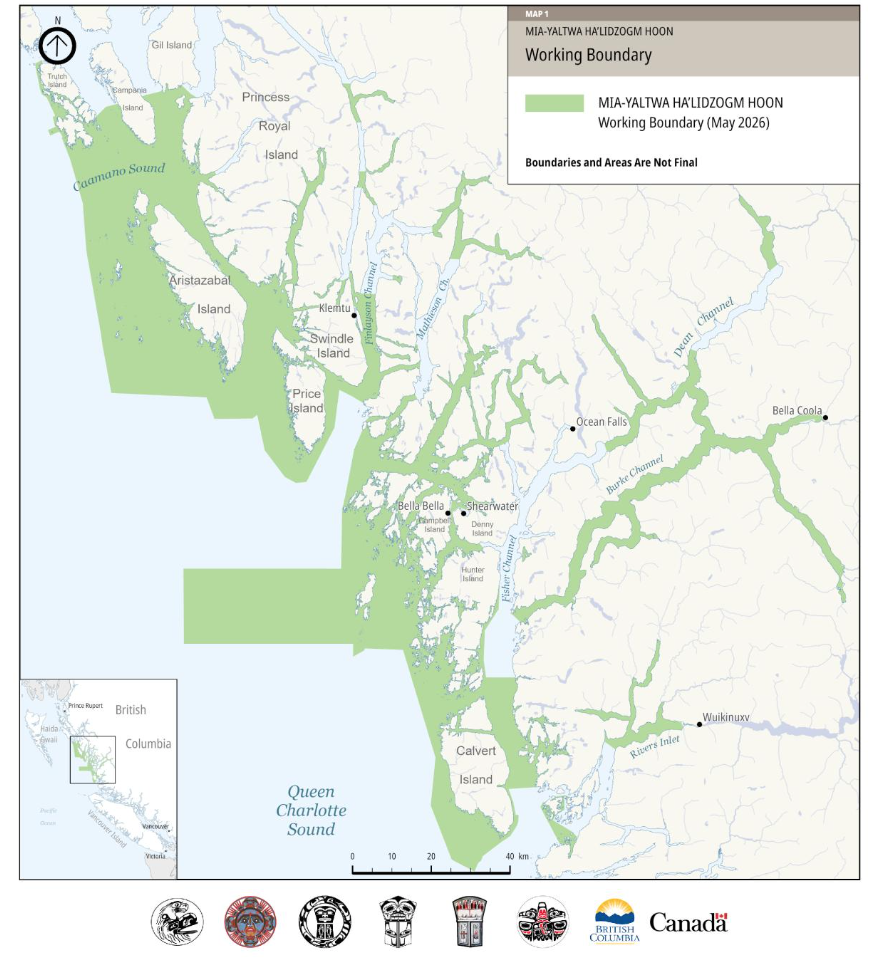
Mia-yaltwa Ha’lidzogm Hoon is a marine protected area (MPA), which is defined as a geographical marine space designed to achieve the long-term conservation of nature by supporting healthy marine ecosystems, maintaining or rebuilding fish and invertebrate populations, and promoting cultural values.
Located in one of the richest marine environments in the world, Mia-yaltwa Ha’lidzogm Hoon, which translates to “Realm of the Salmon, Home of the Salmon”, covers approximately 6,700 square kilometres of coast and ocean. It is characterized by many different habitat types including steep fjords, rocky headlands, sandy beaches, and estuaries. It is home to many species and habitats that make the Great Bear Sea unique in the world, including salmon, sponge reefs, kelp forests, herring, eulachon, killer whales, and humpback whales.
Parks Canada will co-manage the area with six First Nations, the Heiltsuk, Kitasoo-Xai’xais, Nuxalk, Wuikinuxv, Gitga’at, and Gixaała Nations, who have declared the area an Indigenous Protected and Conserved Area, providing an additional avenue for Indigenous governance of the new site. This area is known for its incredible biodiversity and ecological values, is highly culturally significant, provides food security for First Nations and coastal communities, and supports considerable tourism and recreation and sustainable economic opportunities.
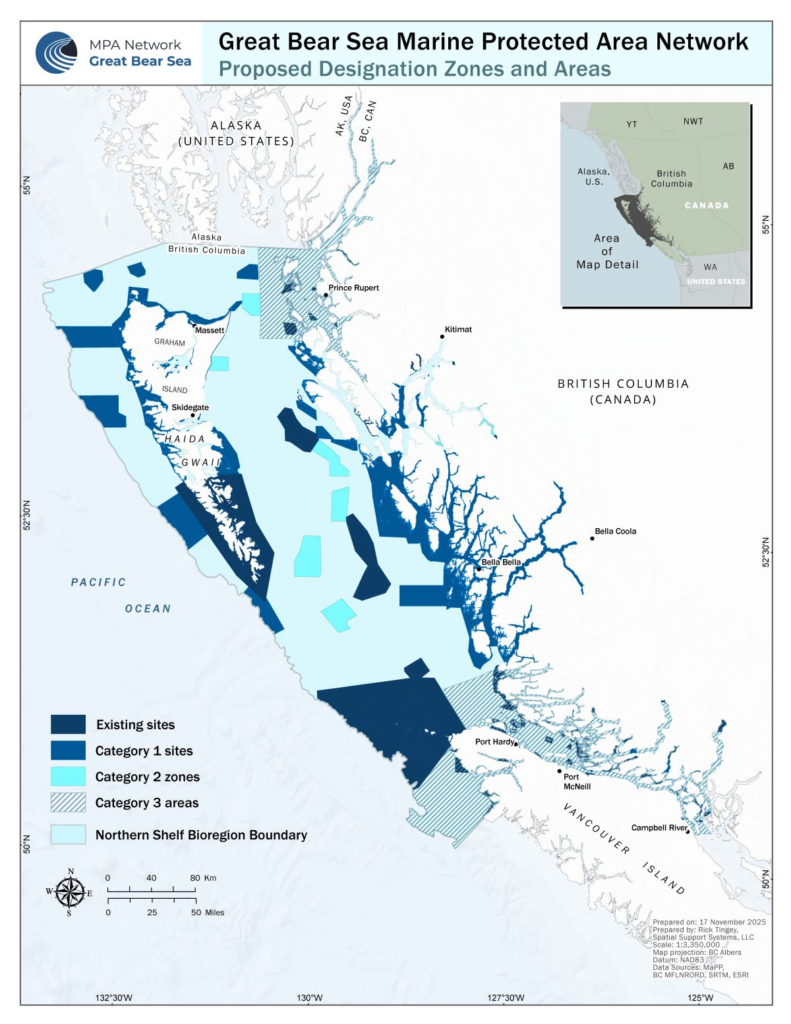
The proposed Mia-yaltwa NMCAR is part of the broader Great Bear Sea Marine Protected Area Network (Figure 2), which is establishing multiple MPAs across the Northern Shelf Bioregion to meet multiple ecological, cultural, and economic objectives and provide benefits to coastal communities. The governments of 17 First Nations, Canada, and British Columbia endorsed a Network Action Plan for the MPA Network in February 2023. The plan provides a roadmap for protecting the marine environment for current and future generations, building off of many years of collaborative planning and the millennia of stewardship of the coastal First Nations in this region. The establishment of the Mia-yaltwa Ha’lidzogm Hoon NMCAR is a key step in the implementation of the Great Bear Sea MPA Network.
While many zones within the Mia-yaltwa MPA will restrict access for some commercial and recreational fisheries, aquaculture, and other human activities, the area will be a mixed use site, where fisheries, aquaculture, tourism, and other human uses will still be allowed to take place in a sustainable manner in some zones. Much like Gwaii Haanas NMCAR and Haida Heritage Site, the development of these zones will take place during the establishment phase with input from all of the communities and stakeholders that care about the region, including the tourism industry. We are honored to have the opportunity to provide our perspective on the benefits of protecting this unique area to help support healthy ecosystems and enhance marine species, protect coastal habitats, reduce human stressors, and support community well being.
While the establishment agreement is the first step in the implementation of the protected area, the declaration is a big accomplishment in what has been a complex co-governance process. It marks the joint commitment of partners to protect and co-manage the area to meet the needs of current and future generations and to continue to work towards management planning and zoning.
The co-development and management of Mia-yaltwa Ha’lidzogm Hoon shows how multiple Nations and crown agencies, coastal communities, and stakeholders can come together and work to create positive ecological, cultural, and economic outcomes for British Columbia and serves as an exemplar for the global community of conservation practitioners. We look forward to participating in this incredible journey with all of the partners and to contribute to better understanding and stewardship of these special places.