
Maurice Kasprowsky
After humans, killer whales are likely the second most widely distributed mammal on the planet. They occur in every ocean and are considered a truly cosmopolitan species. Not all killer whales are the same though. Different populations look different, behave differently, hunt different prey, and, crucially, they do not interbreed. Scientists refer to these distinct populations as ecotypes. Currently, ten killer whale ecotypes are recognised worldwide. Remarkably, three of these ecotypes call the coast of British Columbia home: Bigg’s (Transient), Resident, and Offshore killer whales.
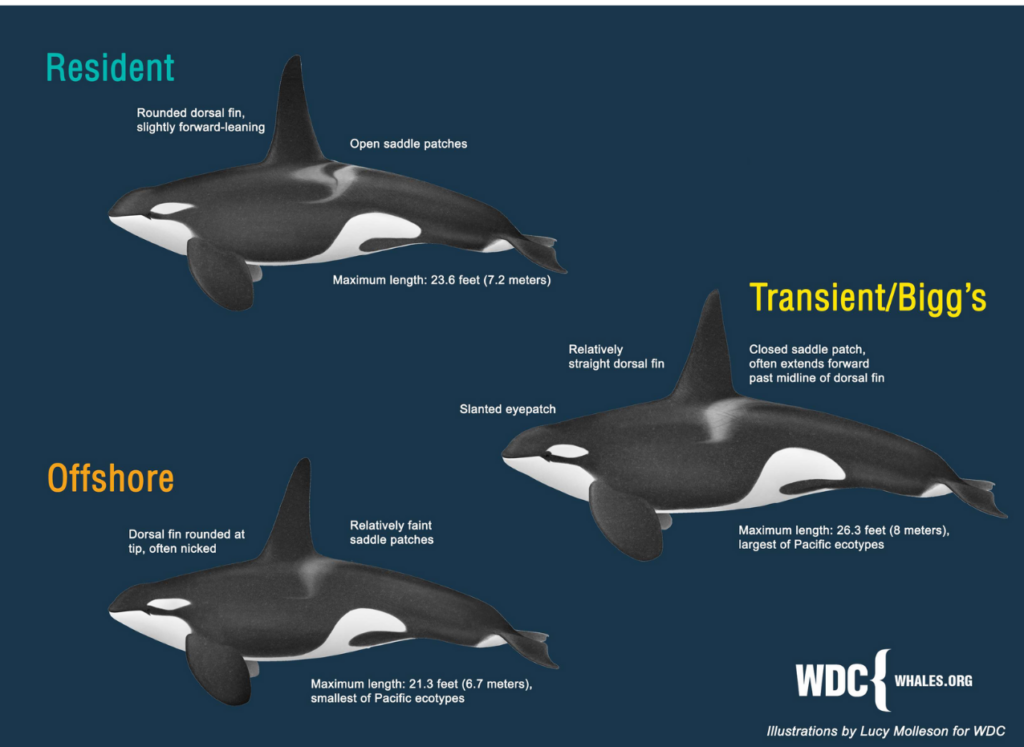
Each ecotype is highly specialised to its environment and food resources, resulting in striking differences between them. Some, like Resident killer whales, focus on salmon, following their migrations. Others, such as Bigg’s killer whales, prey on marine mammals in coastal waters. Offshore killer whales, rarely seen, venture far into the open ocean where they specialise in hunting sharks.
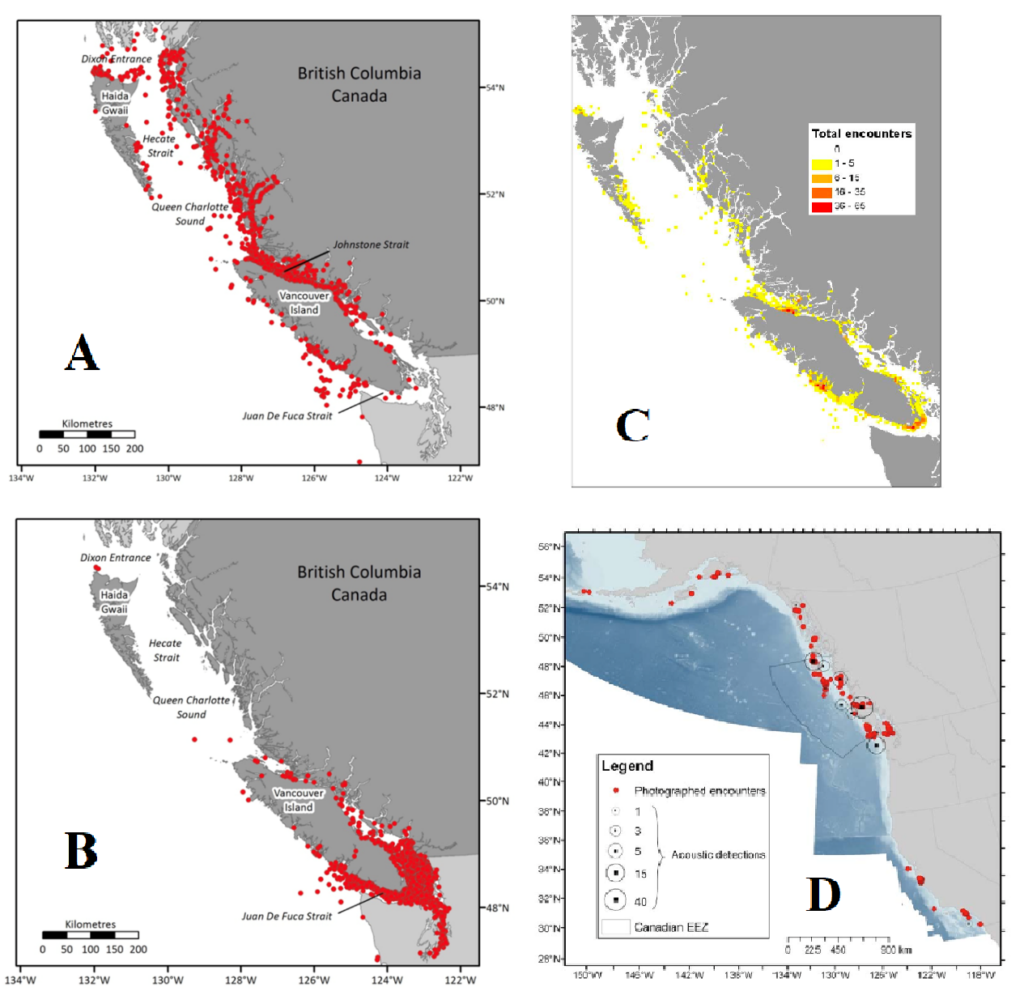
The coast of British Columbia is uniquely positioned in this story. Nowhere else in the world do three killer whale ecotypes overlap in such a small range while remaining completely distinct. These populations are also among the most extensively studied whales on the planet. In this article, we will take a deeper dive into the three ecotypes that call the BC coast home.
Bigg’s (Transient) Killer Whales
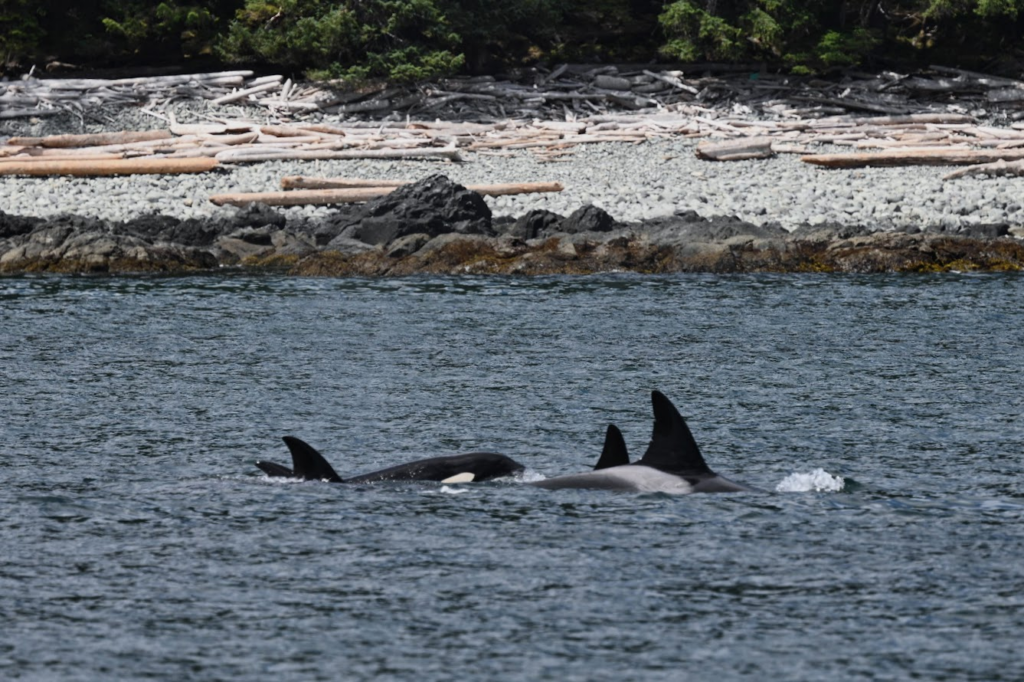
One of the most commonly observed killer whales along the coast of British Columbia (BC) is the Bigg’s Killer Whale, specifically the Northeast Pacific Transient population. These whales range from California to Alaska and typically remain close to shore, where they hunt marine mammals. In BC waters, most specialise in smaller prey such as harbour seals and porpoises, occasionally taking sea lions. Farther south however, particularly along the Californian coast, some groups hunt much larger prey, including humpback and grey whales, usually targeting calves. The population is estimated at roughly 350 individuals and is currently considered healthy and increasing. Following decades of culling in the mid-20th century, legal protection through the Marine Mammal Regulations has allowed this population to recover [4].
Formerly known simply as “Transients”, these whales were renamed in honour of Dr. Michael Bigg, whose pioneering research in the 1970s identified the three distinct ecotypes in BC and established the first comprehensive population assessment in the region. Although Bigg’s killer whales travel vast distances, often covering around 100 kilometres per day, with the same family group documented in Alaska and weeks later in California, the term transient proved misleading [4, 5]. For years they were assumed to be merely passing through regions. We now know that many groups exhibit strong site fidelity, repeatedly visiting specific areas. The T101s, for example, are frequently sighted making regular rounds through Howe Sound. In 2025, Bigg’s killer whales were formally recognised as a separate subspecies, Orcinus orca rectipinnus, translating to “orca with a straight fin,” referencing their straight and pointed fin shape [2, 3].
Bigg’s killer whales live in tight-knit family groups of two to ten individuals led by a matriarch. Males often remain with their mothers for life, while females often disperse when bearing their own offspring and form new groups over time, resulting in a slightly fluid social structure. Their smaller group size supports their main hunting strategy: stealth [6]. Their prey possess acute underwater hearing, which is also why Bigg’s whales are generally quiet hunters, and rarely vocalise or echolocate while hunting. Most vocal activity occurs after a successful kill or during social gatherings known as “T-parties,” when multiple family groups come together to socialise. For Bigg’s killer whales, vocalisations therefore serve primarily social rather than foraging purposes [7].

As apex predators, Bigg’s killer whales have an ecosystem-wide impact. Their presence affects not only prey abundance but also prey behaviour. Harbour seals, for example, have learned to distinguish between the calls of Bigg’s and Resident (fish-eating) killer whales. Only Bigg’s pose a threat, and seals respond accordingly. In turn, Bigg’s whales rely heavily on silence and precise group coordination during hunts, with a diverse set of hunting techniques. They ram prey to stun it, strike with powerful fluke slaps to catapult it into the air, or pull and hold marine mammals underwater to drown them. Many family groups specialise in particular prey types. Some, such as the T019s, are known to target large baleen whales, while others focus primarily on smaller mammals like seals and dolphins. The techniques used vary dramatically depending on prey species and are passed down culturally by the matriarch [8, 9]. There are even reports of some groups (T065s) intentionally beaching themselves to capture hauled-out seals, a behaviour reminiscent of killer whales in South America, and is potentially indicative of a newly emerging cultural hunting technique [10].
Feeding high on the food chain comes at a cost. Bigg’s killer whales carry some of the highest contaminant loads of any ecotype due to bioaccumulation, a process by which toxin concentrations increase as they move up the food web. Many of these pollutants are stored in the fatty blubber, limiting immediate harm. However, during periods of nutritional stress, toxins can be released in the bloodstream. Even more concerning is the transfer of contaminants from mother to calf. Killer whale milk contains roughly 40 percent fat, and fat-soluble toxins are passed to nursing calves, who have not yet developed thick blubber reserves of their own. As a result, first-born calves often show very low survival rates within their first year. Subsequent calves are less impacted as their mother’s contamination burden is reduced through previous nursing [11].
Several individuals have become particularly well known within this population. One is Tumbo (T002C2), who developed severe scoliosis early in life, resulting in pronounced spinal deformities that limited his mobility. His family group, the T002Cs, adapted to his condition, travelling slower and sharing their prey to support him. This case illustrates the strength of social bonds within Bigg’s killer whale family groups. Another notable individual is Tl’uk (T046B1B). Born with typical black-and-white pigmentation, Tl’uk gradually developed increasingly pale coloration, giving him a frosted-white appearance. While the exact cause remains uncertain, researchers suspect Chédiak–Higashi Syndrome, a rare genetic disorder affecting pigmentation and immune function [12].

Resident Killer Whales
Resident killer whales occupy comparatively smaller and more predictable ranges than their Bigg’s counterparts and follow remarkably consistent seasonal movement patterns. In the Pacific Northwest there are four resident populations, two of which occur in British Columbia: the Northern Residents and the Southern Residents. As their names suggest, Northern Residents are most commonly found in the northern regions of BC, north of Campbell River, while Southern Residents are typically sighted south of Campbell River, though both populations travel beyond these core areas. The Southern Resident Killer Whales (SRKW) are highly endangered, with only 74 individuals remaining. In contrast, the Northern Resident Killer Whales (NRKW) number around 300 individuals and are currently considered growing [4]. Both populations are fish-eating specialists with a strong preference for salmon. Southern Residents in particular heavily favour Chinook salmon. Like Bigg’s killer whales, Residents are now recognised as a separate subspecies, Orcinus orca ater, meaning “dark or black orca,” referencing their generally darker appearance and less distinct saddle patch [2, 3].
Residents are smaller than Bigg’s killer whales and live in larger, highly stable family groups of 10–25 individuals. Dispersal is rare, and both males and females typically remain with their natal matriline for life. Their social structure aligns closely with their prey. Fish do not require as much stealth, allowing Residents to travel and forage in larger groups. Unlike Bigg’s, Residents are extremely vocal [1]. They rely heavily on echolocation to locate prey and communicate constantly with one another to coordinate hunts. Their echolocation allows them to differentiate between fish species, by detecting differences in swim bladder size and shape, which often results in the rejection of the less preferred non-salmonid species [13].
Matriarchs play a central role in Resident society. They pass down knowledge of salmon migration routes and seasonal run timing, guiding their families to predictable feeding grounds year after year. They also transmit learned avoidance of areas where the whales have previously experienced disturbance or harassment. This cultural knowledge is essential, particularly during years of low salmon abundance [14].
Their vocal repertoire is highly complex and distinct. The Northern residents are divided into three distinct acoustic clans or matrilines, each with a unique call type. The whales use this acoustic distinction as a way to increase gene flow, as they primarily mate between acoustic clans. These clans are further subdivided into pods, each with its own dialect of shared “discrete calls” used to maintain group cohesion, almost like a verbal signature [15].
A range of unique behaviours has developed within the two populations. Northern Residents are well known for their beach-rubbing behaviour, in which whales deliberately swim into shallow bays and rub their bodies against smooth pebble beaches. This behaviour is thought to aid in skin maintenance and more importantly reinforce social bonds [15]. Southern Residents have more recently been observed engaging in a similar behaviour using kelp to “massage” another [16].
Southern Residents in particular continue to face significant conservation challenges. In the 1960s and 1970s, live captures for marine parks disproportionately removed juveniles and females, limiting long-term population growth. Today, reduced Chinook salmon availability represents the greatest threat to recovery. Nutritional stress has been linked to decreased body condition and lower reproductive success. Despite declining prey abundance, residents have not shifted to alternative food sources such as marine mammals, as their ecological and cultural specialisation remains firmly rooted in salmon [17]. Vessel traffic and noise pollution pose an additional threat, as Residents depend so strongly on sound to forage. Under noisy conditions, they must increase call amplitude and spend more time searching for prey [18].
Several individuals have come to symbolise the resilience and vulnerability of this ecotype. One of the most widely known is Tahlequah (J35), a Southern Resident female who, in 2018, carried her deceased newborn calf for twelve days over more than 1,000 kilometres. Her pod slowed their travel and appeared to assist her in supporting the body. While the precise nature of this behaviour remains scientifically uncertain, it has been widely interpreted as a form of grief. Tahlequah has since given birth to another surviving calf [19].
A notable Northern Resident is Springer (A73), who became separated from her family as a young calf and was found alone in Puget Sound, far outside her population’s typical range. After a coordinated rescue and reintroduction effort, she was successfully reunited with her pod. Springer has since integrated fully and produced calves of her own, demonstrating both the strength of matrilineal bonds and the remarkable social memory of Resident killer whales [20].
Offshore Killer Whales
The most elusive of all killer whale ecotypes is the Offshore killer whale. They roam far from shore in deep oceanic waters and only rarely visit coastal areas. As a result, their exact range is still not fully understood. Most encounters with humans occur near Haida Gwaii [4].
Because of their offshore lifestyle we know far less about these whales than about the other ecotypes. Current estimates suggest that around 300 individuals exist in the Pacific Northwest. Offshores are likely the smallest of the ecotypes and travel in large superpods of 30 or more individuals. Occasionally groups of up to 100 whales are observed. Their eye patches tend to be smaller and their dorsal fins more rounded. They also often have heavily scarred skin, likely the result of interactions with their prey: They hunt sharks and rays [1, 4].
Their diet has one major drawback. Shark skin is covered in dermal denticles, tiny tooth-like scales that make the surface extremely abrasive, almost like sandpaper. As a result, Offshore killer whales often have teeth that are heavily worn down. Because whales only have a single set of teeth and rely on them for hunting, this wear can have significant consequences. To reduce this damage, Offshores are often observed feeding primarily on the liver of their prey. Shark livers are extremely rich in fats and nutrients and are located within softer tissue of the body. In many shark species, the liver alone can make up around 25% of the total body weight. Although the whales lose out on some overall calorie intake, targeting the liver allows them to obtain high-energy nutrients while reducing wear on their teeth [21].
In addition to the usual biting, body strikes, and fluke hits, Offshore killer whales appear to take advantage of a biological weakness in sharks known as tonic immobility, when hunting. When a shark is flipped upside down, it enters a temporary state of paralysis or extreme relaxation and becomes far less responsive to its surroundings. Orcas exploit this by deliberately flipping sharks over and holding them in that position while they remove the liver with almost surgical precision [22].
A striking example of how human impacts reach even the most remote environments is the presence of toxins in Offshore killer whales. Because they feed high up the food chain, similar to Bigg’s killer whales, they accumulate extremely high concentrations of pollutants in their bodies. One of the most common compounds detected in biopsies is PCB, a human-made chemical once widely used in electrical equipment and industrial applications. PCBs are now known to be highly toxic and carcinogenic. Their presence in offshore killer whales shows that pollution produced by humans does not stay where it is released. It travels across entire ocean basins, reaching even the most remote marine predators [23].
We are only beginning to understand the remarkable diversity between killer whale ecotypes, differences that go far beyond appearance alone. Many of these populations have evolved separately for thousands of years, adapting to specific environments and prey, showing how behaviour and culture can drive evolution. At Outer Shores Expeditions, we feel incredibly lucky to encounter this diversity and look forward to continuing to learn more about these fascinating animals in the years to come.
Resources
[1] de Bruyn, P. J. N., Tosh, C. A., & Terauds, A. (2012). Killer whale ecotypes: is there a global model? Biological Reviews, 88(1), 62–80.
[2] Committee on Taxonomy. 2025. List of marine mammal species and subspecies. Society for Marine Mammalogy, www.marinemammalscience.org, consulted on [05/03/2026].
[3] Morin, P. A., McCarthy, M. L., Fung, C. W., Durban, J. W., Parsons, K. M., Perrin, W. F., Taylor, B. L., Jefferson, T. A., & Archer, F. I. (2024). Revised taxonomy of eastern North Pacific killer whales (Orcinus Orca): Bigg’s and resident ecotypes deserve species status. Royal Society Open Science, 11(3).
[4] COSEWIC. 2023. COSEWIC assessment and status report on the Killer Whale Orcinus orca, Northeast Pacific Southern Resident population, Northeast Pacific Northern Resident population, Northeast Pacific Transient Killer Whale population, Northeast Pacific Offshore population, and Northwest Atlantic / Eastern Arctic population in Canada. Committee on the Status of Endangered Wildlife in Canada. Ottawa. xxxi + 114 pp. (Species at risk public registry).
[5] Dahlheim, M. E., & White, P. A. (2010). Ecological aspects of transient killer whales Orcinus orca as predators in southeastern Alaska. Wildlife Biology, 16(3), 308–322.
[6] Baird R. B. (1987). Foraging Behaviour and Ecology of Transient Killer Whales (Orcinus Orca). Simon Fraser University.
[7] Deecke, V. B., Ford, J. K. B., & Slater, P. J. B. (2005). The vocal behaviour of mammal-eating killer whales: communicating with costly calls. Animal Behaviour, 69(2), 395–405.
[8] Ford, J. K. B., Ellis, G. M., Matkin, D. R., Balcomb, K. C., Briggs, D., & Morton, A. B. (2005). KILLER WHALE ATTACKS ON MINKE WHALES: PREY CAPTURE AND ANTIPREDATOR TACTICS. Marine Mammal Science, 21(4), 603–618.
[9] McInnes, J. D., Lester, K. M., Dill, L. M., Mathieson, C. R., West-Stap, P. J., Marcos, S. L., & Trites, A. W. (2024). Foraging behaviour and ecology of transient killer whales within a deep submarine canyon system. PLOS ONE, 19(3), e0299291–e0299291.
[10] McInnes, J. D., Buckmaster, J. N., Cullen, K. D., Mathieson, C. R., & Tawse, J. P. (2020). Intentional Stranding by Mammal-Hunting Killer Whales (Orcinus orca) in the Salish Sea. Aquatic Mammals, 46(6), 556–560.
[11] Lee, K., Raverty, S., Cottrell, P., Zeinab Zoveidadianpour, Cottrell, B., Price, D., & Juan José Alava. (2023). Polycyclic aromatic hydrocarbon (PAH) source identification and a maternal transfer case study in threatened killer whales (Orcinus orca) of British Columbia, Canada. Scientific Reports, 13(1).
[12] Meet the Transient Orcas — Bigg’s Killer Whales — of Puget Sound. (n.d.). Our Wild Puget Sound. https://www.ourwildpugetsound.com/journal/meet-the-transient-orcas-biggs-killer-whales-of-puget-sound
[13] Au, W. W. L., Horne, J. K., & Jones, C. (2010). Basis of acoustic discrimination of chinook salmon from other salmons by echolocating Orcinus orca. The Journal of the Acoustical Society of America, 128(4), 2225–2232.
[14] Ford, J.K.B. (2019). Killer Whales: Behavior, Social Organization, and Ecology of the Oceans’ Apex Predators. Ethology and Behavioral Ecology of Odontocetes. Ethology and Behavioral Ecology of Marine Mammals. Springer, Cham.
[15] Ford, J. K. B. (1989). Acoustic behaviour of resident killer whales (Orcinus orca) off Vancouver Island, British Columbia. Canadian Journal of Zoology, 67(3), 727–745.
[16] Weiss, M. N., John, R. E., Caro-Ruiz, A. M., Ellifrit, D. K., Grimes, C. A., Redmond, T. A., Vargas, A. A., & Croft, D. P. (2025). Manufacture and use of allogrooming tools by wild killer whales. Current Biology, 35(12), R599–R600.
[17] Stewart, J. D., Durban, J. W., Fearnbach, H., Barrett‐Lennard, L. G., Casler, P. K., Ward, E. J., & Dapp, D. R. (2021). Survival of the fattest: linking body condition to prey availability and survivorship of killer whales. Ecosphere, 12(8).
[18] Lusseau, D., Bain, D., Williams, R., & Smith, J. (2009). Vessel traffic disrupts the foraging behavior of southern resident killer whales Orcinus orca. Endangered Species Research, 6, 211–221.
[19] Meet the Southern Residents. (n.d.). Orca Conservancy. https://www.orcaconservancy.org/meet-the-southern-residents
[20] Springer’s Story – OrcaLab. (2018). Orcalab.org. https://orcalab.org/springers-story/
[21] Ford, J., Ellis, G., Matkin, C., Wetklo, M., Barrett-Lennard, L., & Withler, R. (2011). Shark predation and tooth wear in a population of northeastern Pacific killer whales. Aquatic Biology, 11(3), 213–224.
[22] Towner, A. V., Kock, A. A., Stopforth, C., Hurwitz, D., & Elwen, S. H. (2022). Direct Observation of Killer Whales Predating on White Sharks and Evidence of a Flight Response. Ecology, 104(1).
[23] Desforges, J.-P., Hall, A., McConnell, B., Rosing-Asvid, A., Barber, J. L., Brownlow, A., De Guise, S., Eulaers, I., Jepson, P. D., Letcher, R. J., Levin, M., Ross, P. S., Samarra, F., Víkingson, G., Sonne, C., & Dietz, R. (2018). Predicting global killer whale population collapse from PCB pollution. Science, 361(6409), 1373–1376.